
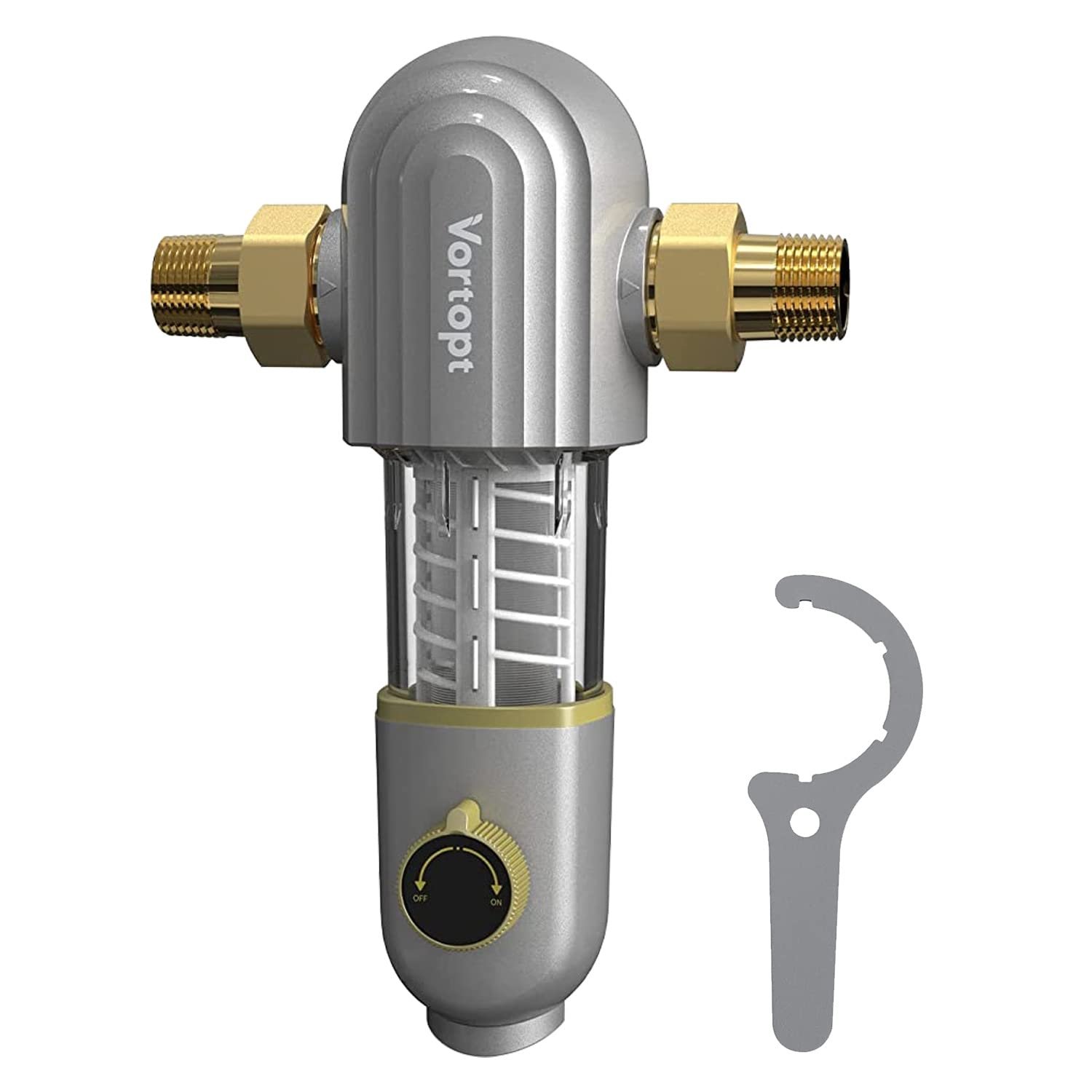
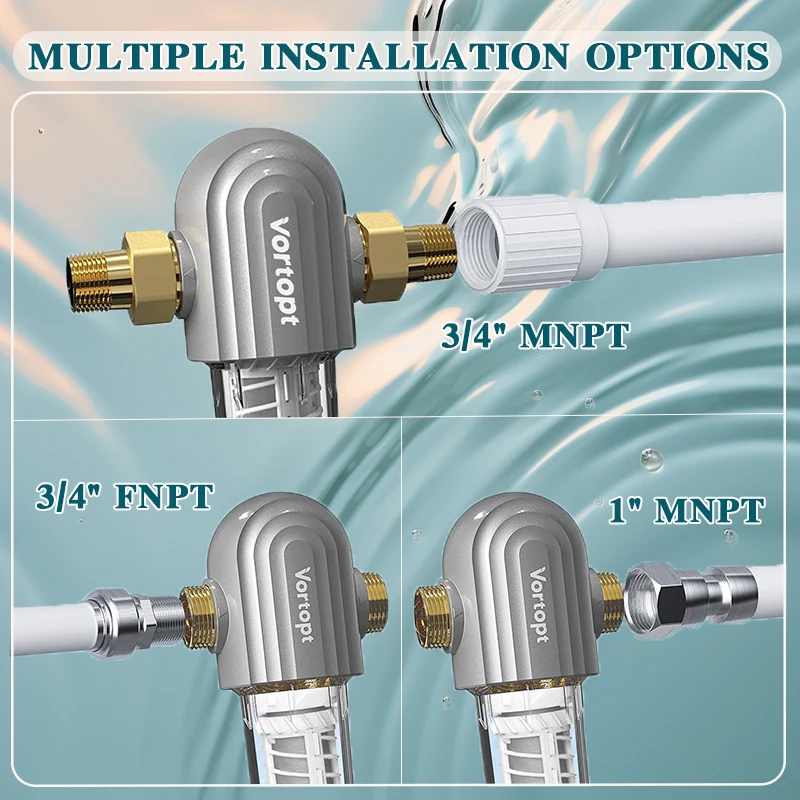
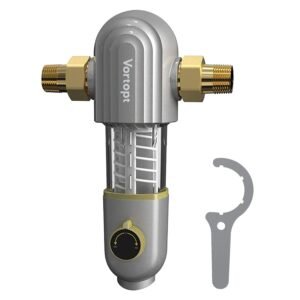
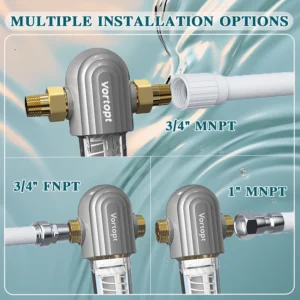
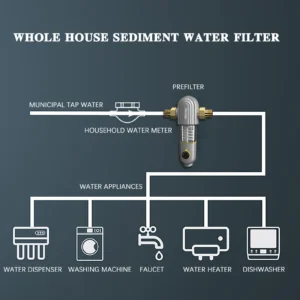
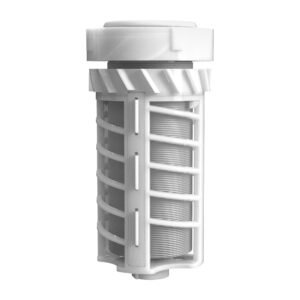
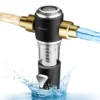
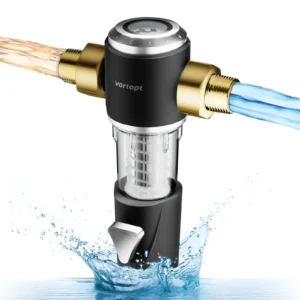
The VORTOPT Q2 spin-down sediment water filter is a 40-micron prefilter for a municipal incoming main water line, currently priced at $49.99. Its manual lists 1-inch MNPT, 3/4-inch FNPT and 3/4-inch MNPT connection formats. It must be installed vertically by a qualified installer with the flow arrow correctly aligned and a suitable drain route planned before work begins.
Q2 is a sediment-prefilter stage, not a final drinking-water purifier. It is not a universal contaminant-removal system. Confirm pipe compatibility, operating limits, service clearance and current package contents before ordering.
Choose the VORTOPT Q2 spin-down sediment water filter for the incoming line
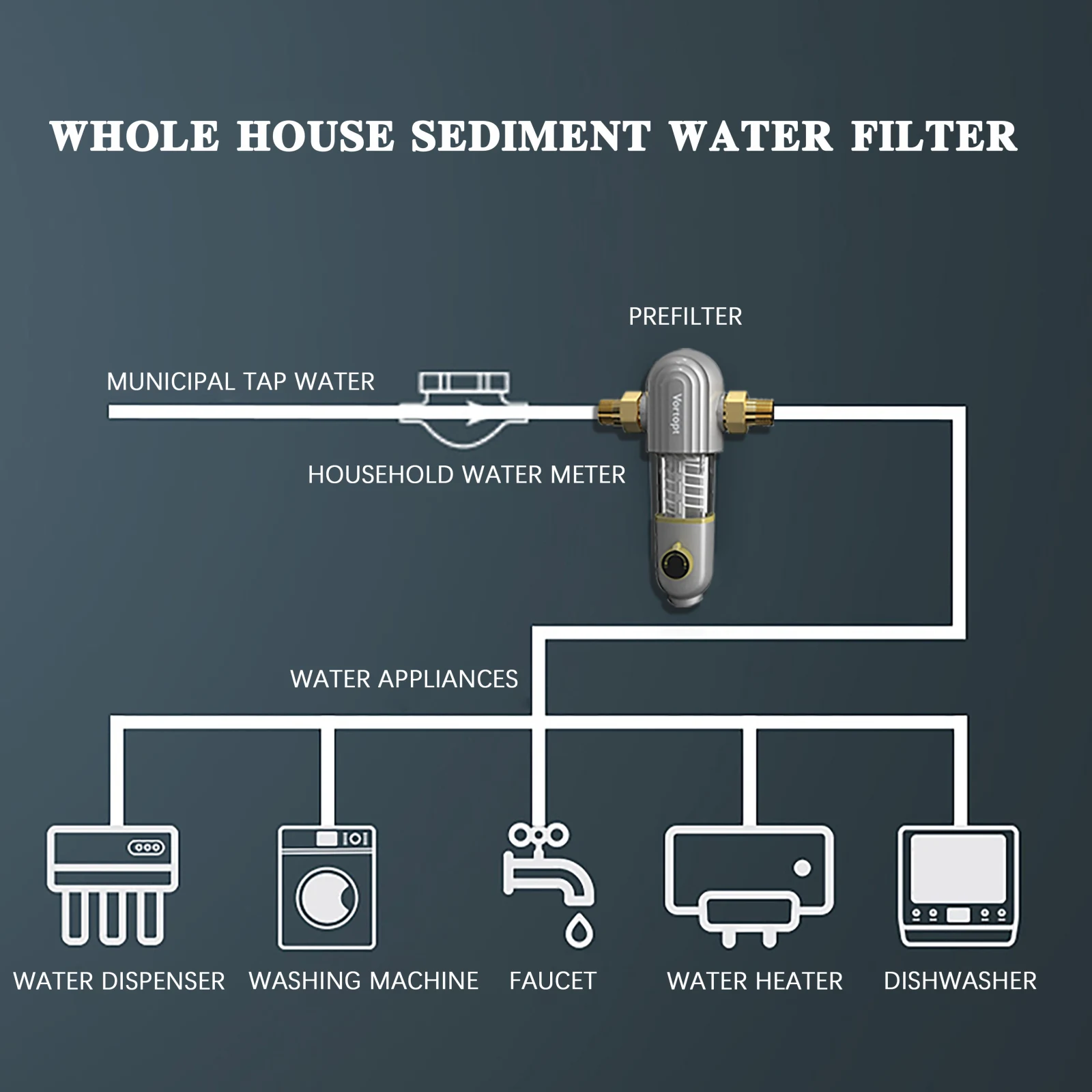
Q2 is designed to sit on the household’s municipal-water supply after the meter and before downstream fixtures. This position lets the reusable mesh encounter incoming particulate matter before water continues through the home. It is a point-of-entry prefilter format, not a replacement for a treatment stage selected for a specific dissolved contaminant, taste concern or drinking-water requirement.
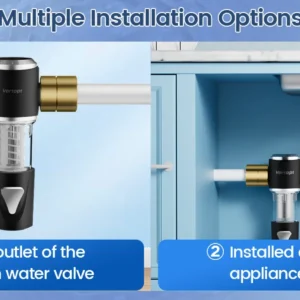
Choose it only after checking the pipe, available working space and drainage route. The published connection formats provide several installation paths, but they do not establish universal compatibility with every plumbing system. If your line material, thread standard or transition fitting is uncertain, ask a qualified installer to identify the existing pipe before purchase. You can also compare other products in the Whole House Water Filters collection.
Understand what the published 40-micron mesh is designed to do
The manufacturer publishes a filtration precision of 40 micrometers for the Q2 mesh. That number describes the nominal physical screening scale stated in the product manual. In practical terms, the unit is presented as a sediment prefilter that can be flushed through its lower drain arrangement instead of being described as a final purifier.
The 40-micron rating should not be turned into claims that have not been documented. This page does not promise removal of microorganisms, dissolved chemicals, taste, odor, hardness or any named contaminant. It also does not claim NSF/ANSI certification or independently verified reduction performance. Select any later treatment stage according to the actual water analysis and its own model-specific evidence.
Check the verified pressure, temperature and water-source limits
| Published item | Q2 value | Ordering or installation check |
|---|---|---|
| Filtration precision | 40 μm | Treat as a sediment-prefilter rating, not a universal purification claim. |
| Filtered-water flow | 1056.69 gal/h, about 17.6 GPM | Manufacturer-published value; actual system conditions can affect flow. |
| Working pressure | 14.5–145 psi | Confirm the site’s normal and peak pressure. |
| Ambient temperature | 41–104°F | Do not install where the environment falls outside the published range. |
| Documented water source | Municipal tap water | The manual excludes wastewater and corrosive liquids. |
The manual also prints a “rated clean water flow” field of 264172.49 gallons. Because the source does not establish how that field should be converted into a guaranteed service interval, this listing does not present it as filter life, capacity or a replacement deadline.
Match one of the three listed connection formats
The Q2 manual lists three connection formats: 1-inch MNPT, 3/4-inch FNPT and 3/4-inch MNPT. MNPT indicates a male national pipe thread and FNPT indicates a female national pipe thread. The correct choice depends on the existing line, the direction of the transition and any fittings needed for the pipe material.
Measure and identify the actual connection rather than choosing from nominal appearance. A 3/4-inch pipe label alone does not tell you whether the required mating side is male or female. PPR work requires professional hot-melt equipment, while metal-pipe installations may require additional parts that are not defined as included accessories. Do not use adapters that reduce engagement, cross-thread the body or place unsupported weight on it.
Plan dimensions, vertical orientation and drainage clearance
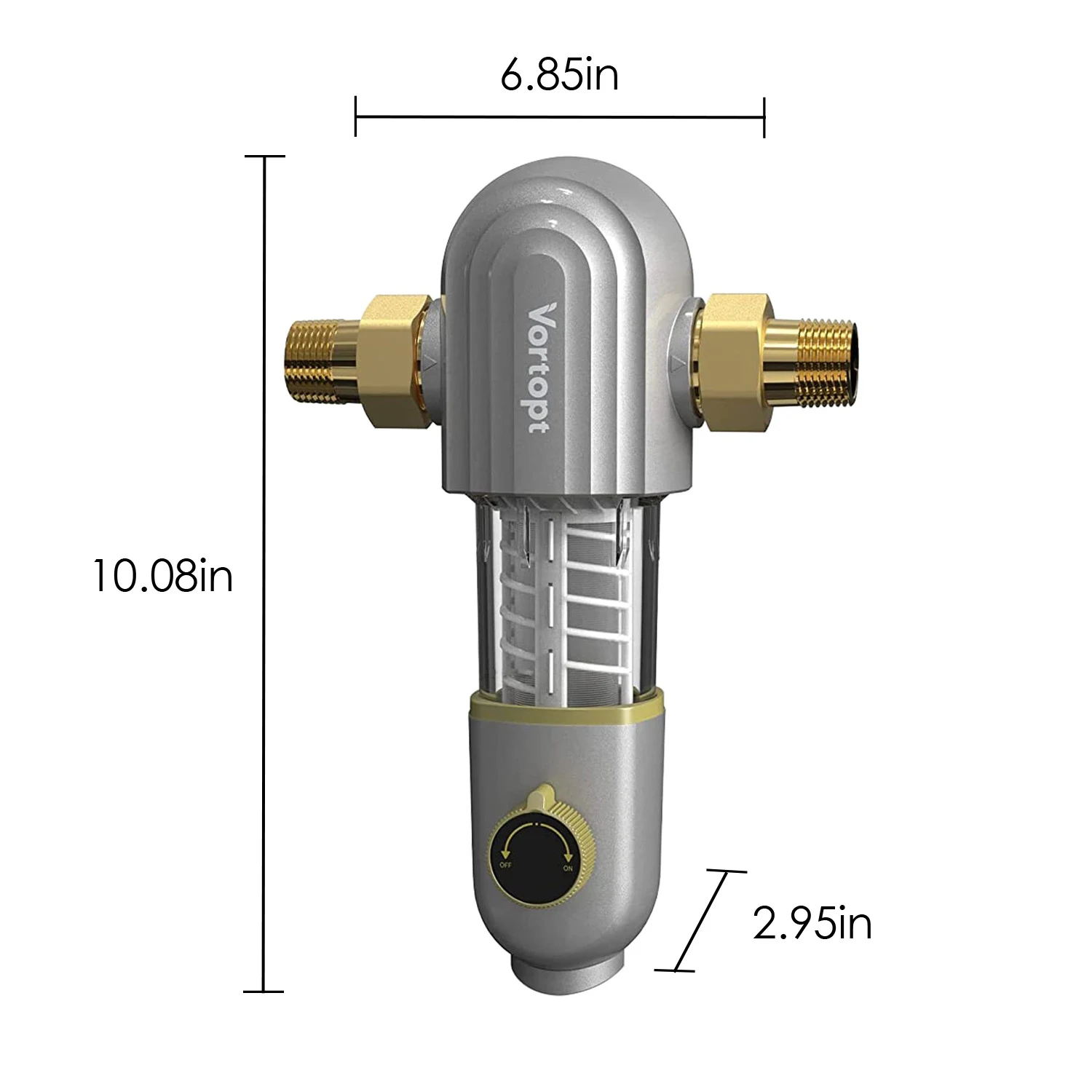
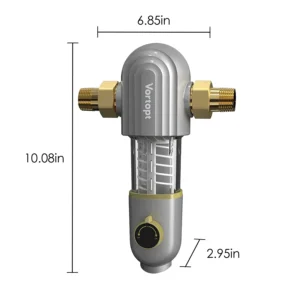
The published dimensional drawing shows approximately 6.85 inches across, 10.08 inches in overall height and 2.95 inches at the indicated lower-body projection. The manual recommends reserving about 5.04–5.2 inches of pipe width and more than 11.81 inches of sewage or drain-service space beneath the unit.
Install the Q2 vertically. The clear lower chamber, drain ball valve and scraping control need room for inspection and operation. Clearance should also allow the drain tube to run without a sharp bend, crushing or an unsafe discharge point. Leave enough access for later mesh washing; placing the unit tightly against a wall or cabinet can turn routine service into a pipe-removal job.
Confirm the current package contents before installation
| Manual-listed component | Quantity or description | Pre-installation action |
|---|---|---|
| Q2 body | One main unit | Check housing, clear chamber, controls and flow arrow. |
| Connection pieces | Two hex nuts and two 3/4-inch MNPT components | Match them to the chosen pipe plan. |
| Sealing parts | Two sealing gaskets and one O-ring | Inspect for cuts, distortion or missing pieces. |
| Service items | Wrench, PE drain pipe and Teflon tape | Verify receipt and follow the current instructions. |
Packaging can change, so the manual list is a preparation reference rather than a promise that overrides the current delivered carton. Photograph the opened package and contact VORTOPT support before installation if a listed part is missing or damaged.
Use a professional installer and follow the flow direction
Shut the main inlet valve and open a downstream faucet to release residual pressure and water before cutting or opening the line. The installer should confirm that the site pressure, pipe material, connection standard, reserved width and drain plan are suitable. Position the unit vertically and align the arrow on the valve body with the actual direction of pipeline flow.
Support the surrounding pipe so the Q2 body does not carry mechanical strain. Complete the appropriate threaded, PPR or metal-pipe connection method with the specified seals. Do not reverse the flow arrow or rotate the assembly into a horizontal position merely to make it fit. Compare the intended location with the product gallery before work begins, but follow the current printed instructions and local plumbing requirements during installation.
Connect the drain line and test every joint for leaks
Push the PE drain pipe fully into the documented drain connection and route it to a reliable discharge point. The tube should remain secure when the valve is opened and should not discharge where water can damage flooring, cabinetry, electrical equipment or stored items. Keep its end positioned so wastewater cannot siphon back toward the unit.
Restore the inlet gradually. Inspect the two pipeline connections, seals, clear chamber, drain-valve area and tube connection while the line is under pressure. Open and close the flush control as directed and inspect again. If any joint leaks, stop the water and correct the exact seal, thread, nut or weld problem; extra force is not a substitute for correct alignment. Review the shipping policy and returns information before modifying or installing the product.
Follow the staged first-use commissioning instructions
The supplied English manual describes first use as a staged commissioning and flushing process, with timing language that should be followed from the current booklet packaged with the unit. This page does not replace that sequence with a simplified drinking-water instruction. Keep the drain route visible, restore pressure gradually and observe the unit through each stage.
Confirm stable joints and controlled discharge before leaving the installation unattended. If the packaged booklet differs from an older copy, or its sequence is unclear, pause and ask VORTOPT for the current Q2 instruction rather than guessing. Commissioning flush water should be routed safely; the Q2’s sediment-prefilter role does not itself establish that downstream water meets a particular drinking-water standard.
Use the spin-down scraping and flush controls
For routine flushing, the manual directs the user to turn the drain ball valve in the indicated direction and rotate the scraping knob clockwise or counterclockwise three to four times. This action is intended to assist the spin-down cleaning process before discharge through the drain line.
The manual calls for flushing at least monthly and describes three valve cycles of 30 seconds each, with frequency adjusted for local water conditions. Stay beside the unit while the valve is open, watch the drain route and close the valve completely afterward. If the home will be unused for an extended period, the manual instructs the user to close the water inlet valve. Never leave a leaking valve or unsecured drain tube under pressure.
Clean the mesh and troubleshoot low flow or leakage
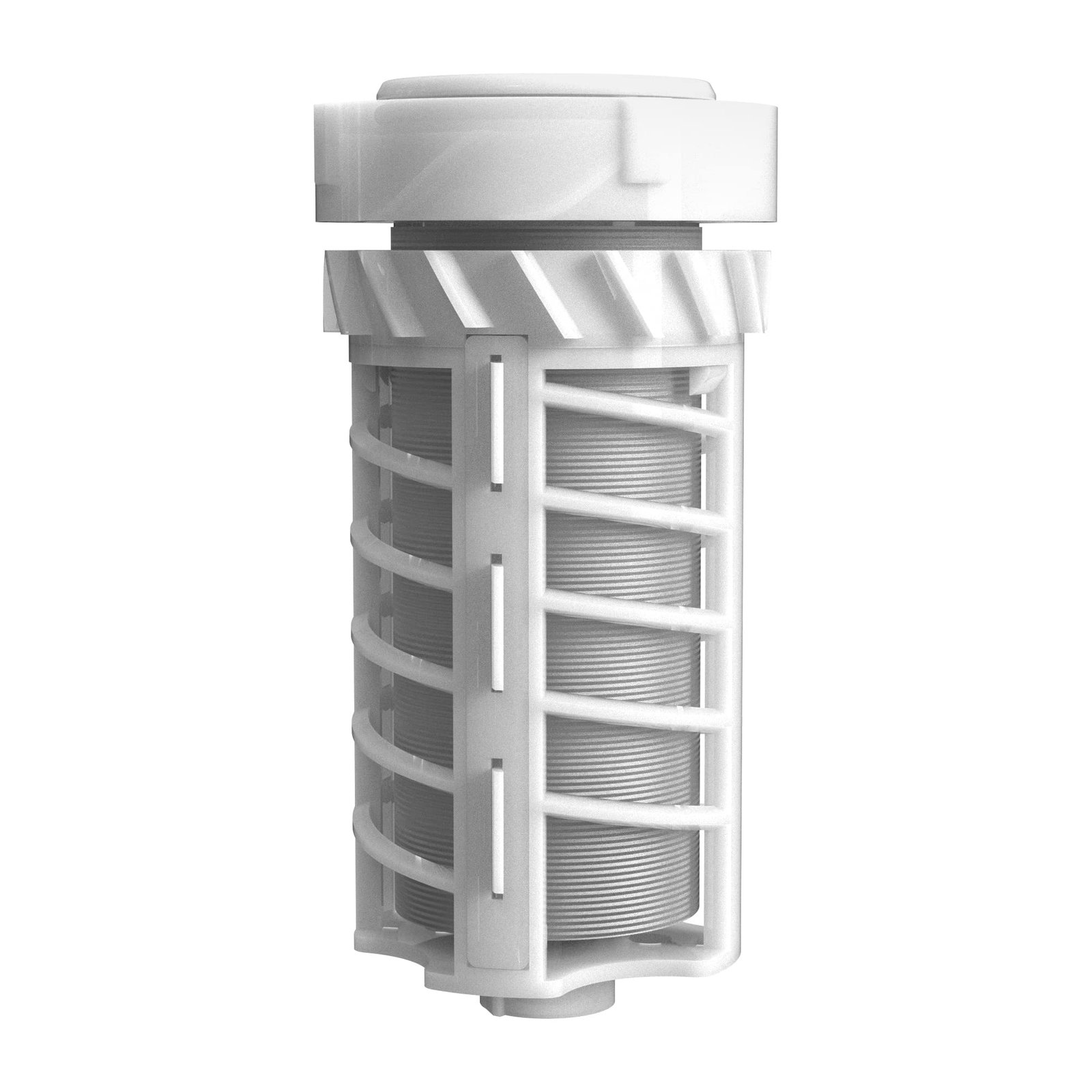
After approximately 8–12 months, the manual recommends professional washing of the filter-mesh component. That is a cleaning recommendation, not a guaranteed service life or fixed replacement interval. The matching VORTOPT VT-SPWF-F replacement listing is identified for Q2, and the broader Replacement Filters category is available for comparison. Confirm the model label before ordering; similar shape alone does not prove compatibility.
If no water passes, check the main supply and inlet-valve position first. For reduced flow, consider whether the mesh needs the documented flush or professional cleaning. For leakage, shut the inlet and inspect seals, loose joints, thread alignment and PPR welding as applicable. Do not operate a cracked housing or improvise a seal. Q700 and Q800 are separate whole-house formats; compare the VORTOPT Q700 and VORTOPT Q800 pages without assuming parts are interchangeable.
VORTOPT Q2 spin-down sediment water filter FAQ
Is the Q2 a final whole-house drinking-water purifier?
No. It is presented as a 40-micron sediment prefilter. This page does not claim final drinking-water purification, universal contaminant removal or a water-safety guarantee.
What does the published 40-micron rating mean?
It is the filtration precision published for the reusable mesh. It should be understood as a physical sediment-screening specification, not proof of certified reduction for named contaminants.
Which connection formats are listed for Q2?
The manual lists 1-inch MNPT, 3/4-inch FNPT and 3/4-inch MNPT. A qualified installer should match the required thread and pipe-transition arrangement.
Can the Q2 be installed horizontally?
No. The manual specifies vertical installation. Preserve the required lower drain/service clearance and align the body arrow with pipeline flow.
How often should the spin-down filter be flushed?
The manual states at least monthly and describes three 30-second valve cycles, adjusted for local water quality. Follow the current booklet and monitor the drain throughout.
Does the mesh have a fixed replacement interval?
No fixed replacement interval is established. The manual recommends professional mesh washing after roughly 8–12 months; service needs should follow inspection and current model guidance.
Is the Q2 approved for untreated well water?
The manual identifies municipal tap water and does not establish untreated well-water approval. Do not extend broader advertising language beyond the model-specific manual.
What should I confirm before ordering or installation?
Confirm the municipal source, pressure, ambient temperature, thread format, vertical space, drain route, pipe material and current package contents. See the general VORTOPT FAQ or contact support when any item is unclear.
| Weight | 2.866009 lbs |
|---|
Be the first to review “VORTOPT Q2 Spin-Down Sediment Water Filter”
Related products
Whole House Water Filters
Whole House Water Filters
Reviews
There are no reviews yet.